I thought I would share the following invitation:
Don't forget to RSVP
INDOCTRINATE U: Hard-hitting Documentary Film Screens at The GeorgeWashington University, in the Cloyd Heck Marvin Center 3rd FloorAmphitheater, on March 3, 2008.
February 25, 2008
FOR IMMEDIATE RELEASEContact: Chad SwarthoutPresident, GW College Libertarianschad_s@gwu.edu +1 (630) 730-9815
Speech codes. Censorship. Sensitivity training. Enforced politicalconformity. Intolerance. Hostility to religion. Violations of freedomof speech and conscience. Kangaroo courts. We usually associate suchthings with the repressive regimes of North Korea, China, Cuba, andthe former Soviet Union. But instead, this assault on free thought istaking place all over America--right now--on our nation's campuses.
Produced by On The Fence Films with the support of the Moving PictureInstitute, award-winning filmmaker Evan Coyne Maloney's documentaryfilm Indoctrinate U reveals the ugly truths about academia that youwon't see in glossy admissions brochures.
"When we think of college, we think of intellectual freedom. Weimagine four years of exploring ideas through vigorous debate andcritical thinking," Maloney said. "But the reality is very far fromthe ideal. What most of us don't know is that American collegestudents surrender their rights to free thought and free speech theminute they set foot on campus."
At once a warning and a wake-up call, Indoctrinate U is stirring upcontroversy and sparking much-needed debate. By exposing the highereducation's best-kept secrets, the film--which London's DailyTelegraph found to be "as slick and incisive as anything by MichaelMoore"--is calling for the kind of change academics have longpretended they don't need to make.
"To the tune of tens of thousands of dollars a year, students arebeing robbed of their educations," Maloney said. "Higher education issystematically defrauding students, parents, and taxpayers. And manytrustees, the people who are supposed to be overseeing this system,are letting it happen by failing to act."
Prominent professor Stanley Fish agrees; he recently used hisinfluential New York Times blog to state that "So long as there arethose who confuse advocacy with teaching, and so long as facultycolleagues and university administrators look the other way, theacademy invites the criticism it receives in this documentary."
Now this acclaimed film is coming to The George Washington Universityfor a special one-night-only campus screening. Indoctrinate U willscreen at the Cloyd Heck Marvin Center 3rd Floor Amphitheater, 80021st Street NW, Washington, DC on Monday, March 3, 2008, at 9:00 PM.
The film was produced by a team headed by Stuart Browning, a softwareentrepreneur, blogger, and filmmaker; entertainment attorney BlaineGreenberg; and Thor Halvorssen, former CEO and executive director ofthe Foundation for Individual Rights in Education (FIRE). Frayda Levy,president of the Moving Picture Institute (MPI), served as associateproducer.
MPI is a New York-based organization dedicated to promoting freedomthrough film. To learn more, visit MPI's website at thempi.org orcontact Marina Lyaunzon at marina@thempi.org.
Please RSVP to Chad Swarthout at chad_s@gwu.edu or on Facebook at http://gwu.facebook.com/event.php?eid=8925987197.
----Chad SwarthoutPresidentGW College Libertarianschad_s@gwu.edu
Monday, February 25, 2008


Wednesday, February 20, 2008
Liberty Fund has an Interactive Room Too Good Not to Share
Most know Liberty Fund for their catalog of books and  online library. Now how about a chance to tour their online interactive GOODRICH ROOM. The room's walls have different names throughout history that have helped lead the argument on Liberty. From the Amagi and Gilgamesh to the Declaration of Independence. Each historical figure opens a new tab with a small historical note and its importance for liberty.
If you knew about the catalog but did not know about the online library, then it is time to get acquainted. It is a large database of online materials and difficult to decide where to begin. Liberty Fund has made easier and given us a starting point, HERE. You can log on to create reading lists, share with others, and view other members lists. Can it get any better?
ENJOY!
online library. Now how about a chance to tour their online interactive GOODRICH ROOM. The room's walls have different names throughout history that have helped lead the argument on Liberty. From the Amagi and Gilgamesh to the Declaration of Independence. Each historical figure opens a new tab with a small historical note and its importance for liberty.If you knew about the catalog but did not know about the online library, then it is time to get acquainted. It is a large database of online materials and difficult to decide where to begin. Liberty Fund has made easier and given us a starting point, HERE. You can log on to create reading lists, share with others, and view other members lists. Can it get any better?
ENJOY!
Monday, February 18, 2008
Chris Coyne: After War in D.C. this Thursday must Register

This Thursday Feb. 21 from 6 to 8:30 p.m.
The Institute for Humane Studies and the Mercatus Center cordially invite you to attend a special IHS book forum and reception featuring Christopher Coyne, assistant professor of economics at West Virginia University.
This event will be a great opportunity to connect with alumni, staff, and friends. We'll have a brief reception at 6:30 pm, and the lecture will begin at approximately 7:00 pm with a reception to follow. Beer, wine, and light hors d'oeuvres will be provided. In addition, Dr. Coyne will be available to sign copies of his book immediately following his talk. We will have a limited number of books available for purchase.
Registration is required for this event, as seating is limited. Please register no later than Wednesday, February 20.
The Fund for American Studies is located at 1706 New Hampshire Avenue, NW. The closest Metro is the Dupont Circle station.
Professor Meyer discusses her books this Thursday
Everyone is invited to a GMU Bookstore event:
Professor Carrie Meyer of GMU Economics Department
on her books


FEB 21
Johnson Center
room 116
5 p.m.
Professor Carrie Meyer of GMU Economics Department
on her books
FEB 21
Johnson Center
room 116
5 p.m.
Monday, February 11, 2008
LIVE BLOGGING THE RUSSIAN CONFERENCE
I am attending the Russian video conference at George Mason University which was advertised in an earlier post. The event began at 11:00 AM and although originally began as a small group has increased in size. A good turnout for a video conference. I'll be posting in the comments section.
Thursday, February 7, 2008
Invitation from the Russian Cultural Center and Sergey Samoilenko, Communication Professor, GMU/GWU:
A great initiative is being put forth by the Russian Cultrual Center in Washington , DC
Room: SUB II Room 3 & 4
They would like to invite you and your friends to our video-conference "US-Russia relations - the students' perspective" next Monday.Russian Cultural Center launches a series of online video conferences for young people from Russia
relations - the students' perspective". The first participants of this event will be college students fromMoscow Moscow
For further Questions Please contact:
Evgeny Agoshkov, the Director of Russian Cultural Center,
agoshkov@mail.ru
Sergei Samoilenko
Communication Professor
GMU/GWU
ssamoyle@gmu.edu
Efrata Yitbarek: eyitbare@gmu.edu
GMU Russian club
Thanks to the GMU Russian Club for the invitation.
Room: SUB II Room 3 & 4
They would like to invite you and your friends to our video-conference "US-Russia relations - the students' perspective" next Monday.
relations - the students' perspective". The first participants of this event will be college students from
For further Questions Please contact:
Evgeny Agoshkov, the Director of Russian Cultural Center,
agoshkov@mail.ru
Sergei Samoilenko
Communication Professor
GMU/GWU
ssamoyle@gmu.edu
Efrata Yitbarek: eyitbare@gmu.edu
GMU Russian club
Thanks to the GMU Russian Club for the invitation.
Tuesday, February 5, 2008
Rally against Sweatshops?
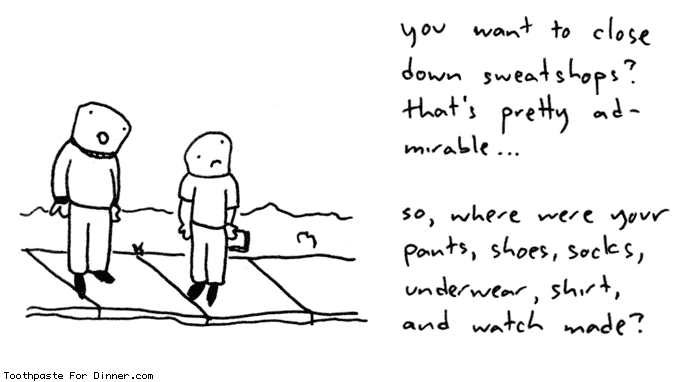
The advertisements are all across the Fairfax campus at George Mason University. The Students for a Democratic Society,SDS, on campus are hosting an anti-sweatshop rally. Now I am not trying to create an Economics Society / Students for a Democratic Society feud here. In fact, I do support the end to the Iraq war (I won't speak for the Economics Society) which is a main cause the SDS oppose.
I am simply stating that sweatshops are good, and that the only problem is there are not enough of them. I know no member within the SDS would agree me (heck, if they did then why are they supporting a group hosting an event?), but give me a chance to let you know why they are good by linking you to this site. He does an excellent job of discussing why sweatshops are good.
Remember as a member of a society we want others to have the ability to find work. The discussion of wage is a discussion between the employer and the employee as it is an individual choice. As the Spanish Scholastics had pointed out
On the issue of the “just wage,” which has been the source of so much contention in Catholic circles over the past century, the Late Scholastics contended that a wage rate mutually agreed upon had to be just. According to Luis de Molina (1535–1600), an employer was “only obliged to pay [the laborer] the just wage for his services considering all the attendant circumstances, not what is sufficient for his sustenance and much less for the maintenance of his children and family.” Domingo
Gratitude for the Mises Institute for the Review of the Chafuen's work on the Spanish Scholastics.
Sunday, February 3, 2008
The questions to ponder within Masonomics
I know, I know. "When is the next event?" That, my friends, is coming, and I must say I am looking forward to it. Expect to find further notices on this blog. Until then...
I am a fool. I had believed that most of the undergraduate students if not all at George Mason University understood the glory of the market and individualism, yet I have found that many have doubts. So lets have at it, what doubts does anyone hold against the market and individualism?
You don't have to leave your question as a comment if you rather have it be more personable you can always email one of the bloggers or to gmueconsociety.gmail.com. This is not for any study merely for the Economics Society to know the views against masonomics.
Also, the views against Austrian economics would be greatly appreciated. According to our poll held last semester Austrian economics is the most popular field, yet it appears many have arguments against it.
Leave us your comments. We are interested with a curiosity unto the ideas of all those reading this blog.
I am a fool. I had believed that most of the undergraduate students if not all at George Mason University understood the glory of the market and individualism, yet I have found that many have doubts. So lets have at it, what doubts does anyone hold against the market and individualism?
You don't have to leave your question as a comment if you rather have it be more personable you can always email one of the bloggers or to gmueconsociety.gmail.com. This is not for any study merely for the Economics Society to know the views against masonomics.
Also, the views against Austrian economics would be greatly appreciated. According to our poll held last semester Austrian economics is the most popular field, yet it appears many have arguments against it.
Leave us your comments. We are interested with a curiosity unto the ideas of all those reading this blog.
Subscribe to:
Posts (Atom)